
Your Logbook Is Your Most Important Legal Document: AIROS at LPA Expo 2026
Every pilot interview starts with the same document: your pilot logbook. It is also the document many pilots stop updating the moment they land the job they wanted.
At the 2026 LPA Aerospace Industry Expo, we saw firsthand how quickly that can become a problem—and how quickly it can be fixed.
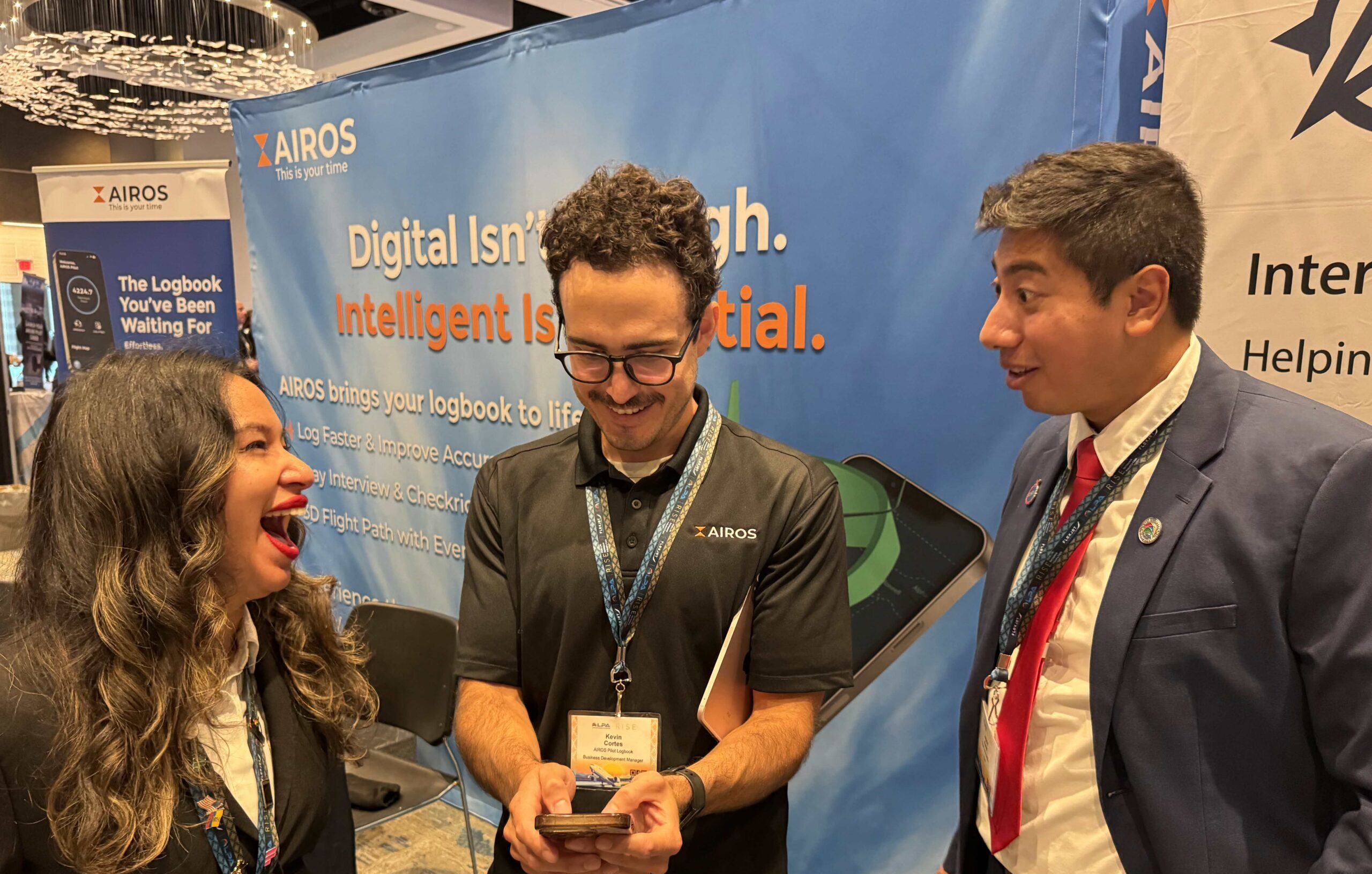
AIROS team members David Spektor and Kevin Cortes, along with AIROS user and advocate Ryan Bingel, spent two days at the expo in Orlando on September 17–18. This year’s event brought together 16 airlines and 65 exhibitors under the theme RISE, celebrating opportunity and professional growth throughout the Latino aerospace community.
It was the right setting for an important conversation about pilot career readiness.
Importing Logbooks Live at the AIROS Booth
Our booth became a working session.
We spoke with pilots at every career stage—from students logging their first hours to captains who had not opened a paper logbook in years—about how they track their flying and what happens when a recruiter asks to see it.
For many pilots, the conversation did not end with a demonstration. We imported their existing logbooks into AIROS right at the booth. Pilots who had not yet started a digital logbook were able to get set up and begin logging their flights.
For those new to AIROS, the reaction was often the same after logging that first flight.
Instead of entering every field manually, a pilot provides the date and either a flight number or tail number. AIROS then populates the aircraft information, route, and flight time using real flight data. An entry that might otherwise take several minutes can be completed in seconds—and does not depend on the pilot reconstructing the details from memory.
What the AIROS Import and Audit Process Uncovered
The most eye-opening moments came after the imports were completed.
Every AIROS logbook import includes an audit designed to surface errors and discrepancies. At the expo, pilots discovered issues they had no idea were in their records.
These were not careless pilots. They were experienced professionals who had diligently tracked their time for years, sometimes across multiple formats. But small mistakes had quietly carried forward from page to page and platform to platform.
Many digital logbooks function primarily as electronic versions of paper records: they store the information entered, including any errors. Over time, those discrepancies can accumulate.
AIROS approaches the process differently. It audits imported entries and identifies inconsistencies that another logbook may simply carry over.
Logbook accuracy remains the pilot’s responsibility—even when the pilot does not know an error exists. A logbook is a legal record presented to the FAA, recruiters, and airline hiring teams. The pilot is accountable for the information it contains.
A discrepancy you do not know about is one you cannot explain. The last place you want to discover it is across the table from an airline hiring panel.
For the pilots we met in Orlando, identifying those issues on the expo floor gave them an opportunity to correct their records before their next interview.
“Grounded Overnight”: Our LPA Breakout Session
On Friday, AIROS hosted a fireside chat titled Grounded Overnight: How a Spirit Pilot Rebuilt His Logbook and Landed Two Offers.
When Ryan Bingel’s situation at Spirit changed with almost no warning, he was ready to pursue his next opportunity—but his logbook was not. He had not updated it in years because he believed his last airline interview was behind him.
Without a complete and accurate record of his flight time, he could not move forward confidently in the hiring process.
Ryan’s old flight schedules and expense reports held the essential clues: dates, flight numbers, and trips whose details he no longer remembered. That was enough to begin rebuilding his history with AIROS.
For each flight, Ryan entered the date and flight number. AIROS retrieved the aircraft information, route, and flight time needed to complete the entry. Years of missing flight history that could have taken weeks to reconstruct manually were returned to his logbook, one entry at a time.
With an accurate, interview-ready logbook, Ryan has since received two job offers.
Ryan was joined by David Spektor, 767 captain and founder and CEO of AIROS, and Ernie Meeks, Southwest captain and founder and CEO of Aviator Intelligence. Together, they brought both the line-pilot and pilot-career perspectives to the discussion.
Three Lessons About Pilot Career Readiness
Career disruption does not always come with a warning
Ryan’s experience is a reminder that a secure position today does not guarantee stability tomorrow. Mergers, shutdowns, furloughs, and unexpected opportunities can arise at any point in a pilot’s career.
Pilots who prepare before circumstances change are better positioned to respond quickly and pursue the next opportunity.
Logbook accuracy can determine who moves forward
In a competitive hiring process, gaps, inconsistencies, and outdated totals can delay an application before a pilot ever sits down with a recruiter.
As the audits at our booth demonstrated, many of these problems remain invisible until someone actively looks for them. A pilot logbook is more than a regulatory record. It is the foundation of a pilot’s professional history.
Readiness should be a habit, not a scramble
Ryan was able to rebuild his flight history, but reconstructing years of flying is far more difficult than maintaining a current logbook.
When logging a flight is as simple as entering a date and a flight or tail number, there is no reason to fall behind. The best time to get your logbook in order is before you need it.
Thank You, LPA
Thank you to Latino Professionals in Aerospace, its volunteers, and every member who stopped by to talk with us about their logbooks.
The energy in Orlando was a powerful reminder of how much talent is rising throughout the aviation industry. We are proud to help pilots protect their flight history and arrive at their next opportunity prepared.
Missed AIROS at LPA Expo 2026?
You do not have to wait for the next expo to get your logbook in order.
Whether your flight history is stored in paper logbooks, another digital platform, or several different formats, AIROS can help you bring it together. Import your records, see what the audit uncovers, and keep every new flight current with just a date and a flight or tail number.