
Importing a Pilot Logbook Should Be More Than Moving Data
Your flight history is too important for a simple file transfer.
Moving to a new digital logbook should make managing your flight history easier. But the quality of an import cannot be measured only by whether every row in a file makes it from one system to another.
The real question is: Did the information arrive accurately, completely and in a form you can trust?
A pilot’s logbook may represent years—or decades—of training, experience and career progression. When that history is imported, dates must align, airports and aircraft must be correctly identified, approaches and holds must be captured, and remarks and custom fields must carry over as intended.
Even when a source file appears complete, differences in how logbook systems organize and label data can create problems during the transition. A column may be interpreted incorrectly. An airport identifier may be ambiguous. Aircraft information may be incomplete. Important details may be buried in remarks or stored in a format that does not translate cleanly.
That is why importing a logbook should never be treated as a routine upload. It should be treated as a careful transfer of one of a pilot’s most important records.
A Successful Upload Is Only the Beginning
Importing thousands of entries in seconds may sound impressive. But speed means little if a pilot then has to search through years of flights to find missing information, questionable totals or incorrectly mapped data.
The best import process does more than move information. It helps the pilot answer three essential questions:
- Did everything transfer?
- Was the information interpreted correctly?
- Is my logbook ready to use?
That final question matters because imported data does not stay in the past. It becomes the foundation for currency tracking, checkrides, applications, interviews and future flight entries. A small issue carried forward can affect totals, summaries and records produced much later.
An import should therefore provide more than confirmation that a file was received. It should give pilots a clear way to review what came over, understand anything that may need attention and verify the results against the original record.
Building Review Into the Import Process
AIROS has enhanced its import system with this responsibility in mind.
Under the hood, the system has become more precise in identifying airports, completing aircraft details, and parsing information such as approaches, holds and remarks. These improvements reflect months of real-world feedback from pilots and the many different ways flight history can be structured across logbooks and files.
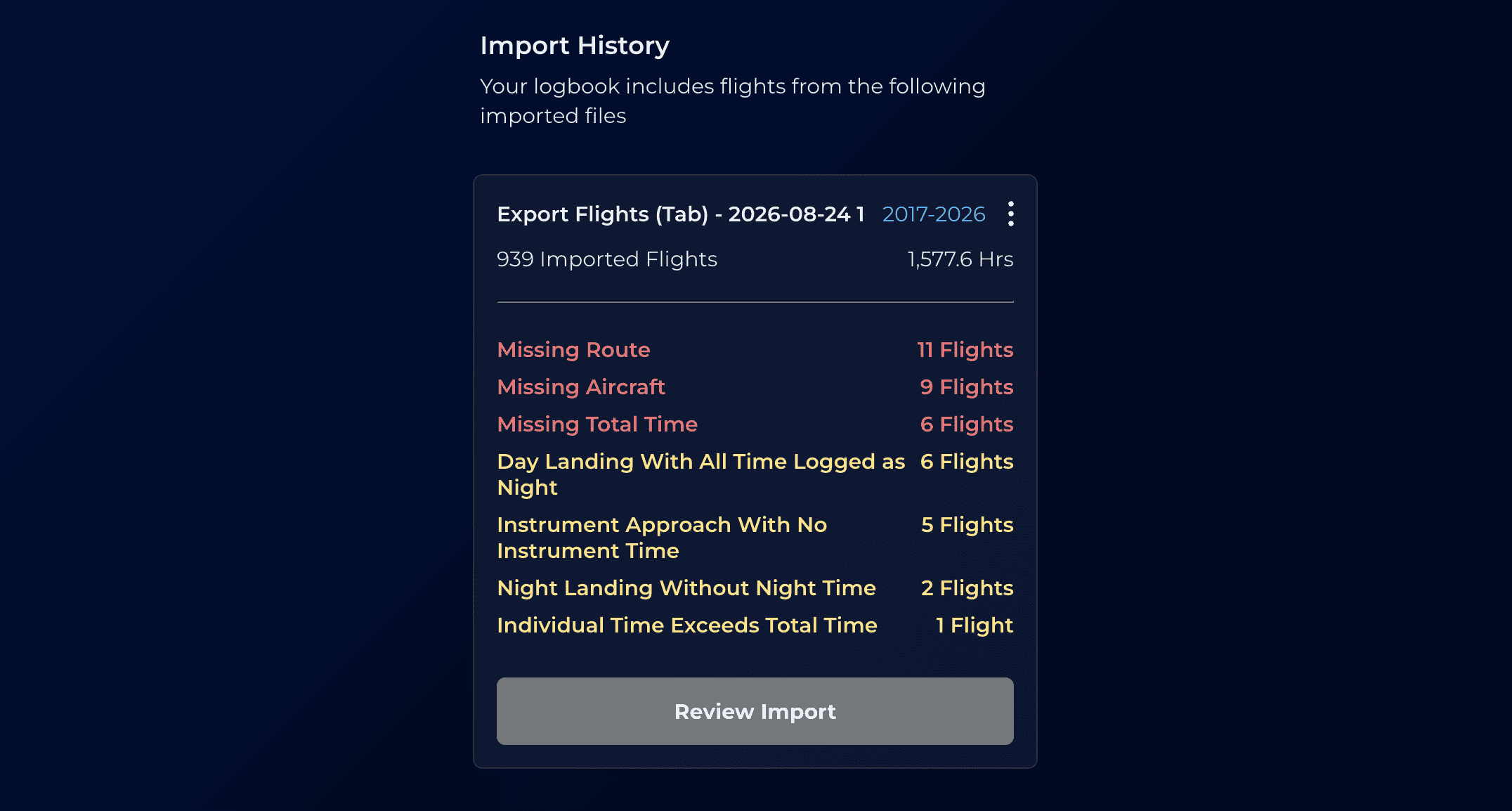
Just as important, AIROS now provides an enhanced Import Review workflow that brings potential issues to the surface instead of leaving pilots to find them on their own.
The review separates identified items into two categories:
- Errors identify entries missing fundamental information required under 14 CFR § 61.51, such as the date, aircraft identification, total time or route.
- Warnings identify entries that may not necessarily violate the regulation but could still deserve attention—for example, a night landing without recorded night time, an instrument approach without instrument time, or PIC and SIC time logged on the same flight.
This distinction is important. Not every unusual entry is wrong, and automated software should not make that assumption. But a strong digital logbook should recognize when something deserves a second look and give the pilot the information needed to make that determination.
Review the Details Without Losing Your Place
Finding an issue is only helpful if correcting it is straightforward.
From the new Import Review, AIROS takes pilots directly to the individual flight, airport, aircraft or custom field that needs attention. Once the item has been reviewed or edited, the pilot returns to the import workflow and can continue with the next one.
This creates a more focused review process. Pilots do not have to move back and forth through different parts of the logbook, search for a particular entry and then try to remember where they left off.
AIROS also displays the airports, aircraft and custom fields identified during the import. Pilots can review those details and correct anything that was interpreted differently from the way they intended.
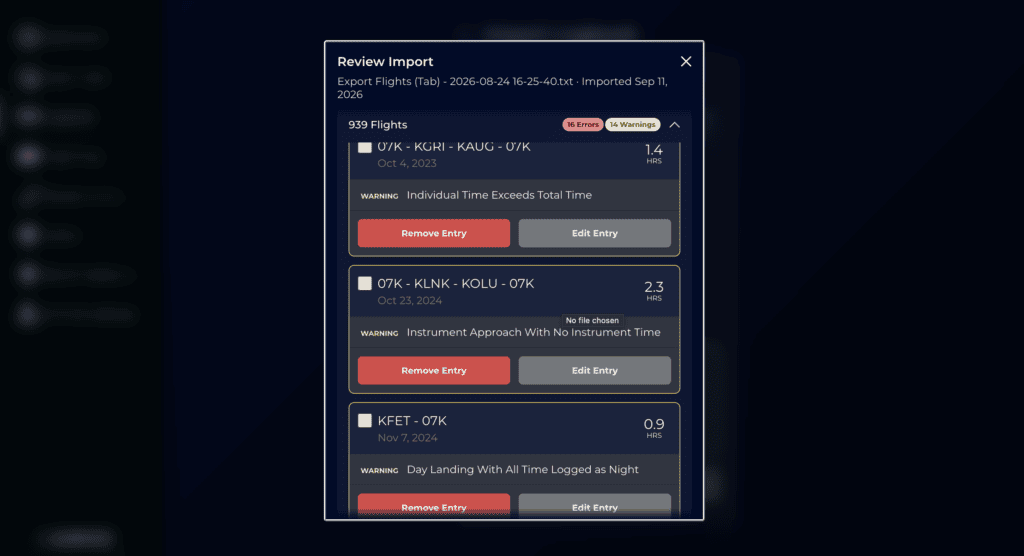
The objective is not to make the import process feel more complicated. It is to make the important work of verification more organized, visible and manageable.
Totals Are the Final Cross-Check
Most pilots naturally compare the totals in a newly imported logbook against the bottom line of the source file. It is one of the clearest ways to confirm that the full record made the move.
AIROS now brings the relevant totals into the Import Review so pilots can make that comparison directly. Instead of navigating between multiple screens or manually reconstructing the numbers, they can review the imported totals alongside the results of the import.
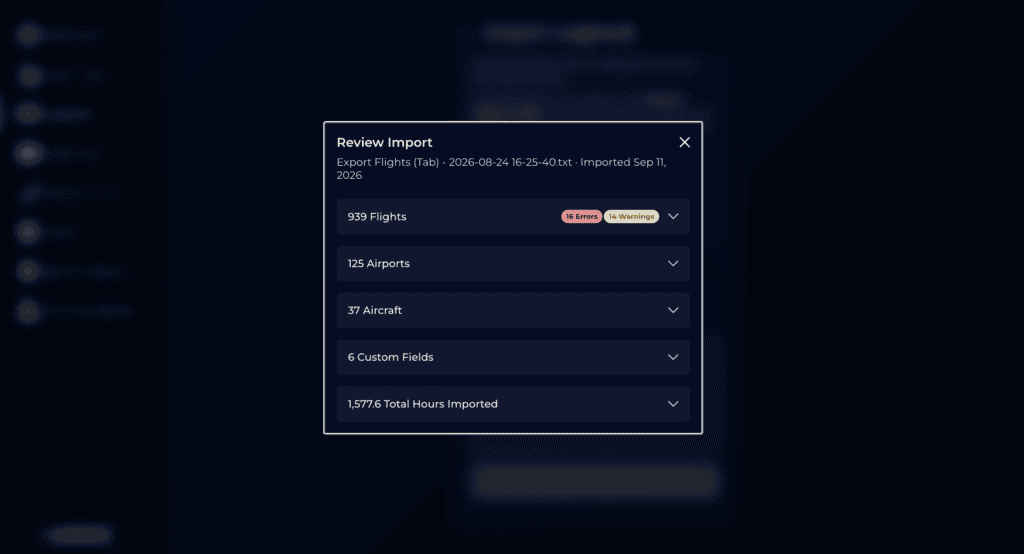
Matching totals do not replace a detailed review, but they provide an important confirmation that the record is complete. When combined with entry-level error and warning detection, they give pilots a more practical way to validate both the details and the bigger picture.
Accuracy Should Continue After the Import
Import review should not be a one-time checkpoint that disappears once setup is complete.
AIROS now allows pilots to filter their logbooks for entries with errors or warnings, making it easier to return to outstanding items at any time. The system also checks for unresolved issues when a pilot prepares to export the logbook as a PDF.
Pilots remain in control and can choose to export anyway. But before creating a document that may be used for a checkride, interview or application, AIROS provides one more opportunity to review anything that could invite questions.
This reflects a larger principle: good logbook technology should not simply store information. It should help protect the quality of that information at the moments when accuracy matters most.
Your History Deserves a Thoughtful Transition
Switching logbooks should not require pilots to choose between convenience and confidence. They should be able to bring their history forward efficiently while still understanding exactly how that information was interpreted.
That requires more than a file uploader. It requires systems that can recognize different data structures, flag potential inconsistencies, support efficient corrections and help pilots verify that the final record matches the one they started with.
At AIROS, we take imports seriously because we understand what is being entrusted to us. It is not merely a collection of rows and columns. It is the documented record of a pilot’s experience—and the foundation for what comes next.
Ready to bring your flight history into AIROS? Import your existing digital logbook free and review your records with greater clarity and confidence.